A Walking Tour of Bayrischzell
Ten stops that show why this village holds far more history than you'd guess at first glance.
Bayrischzell is small. Around 1,600 residents, one main street, two churches, and that's it, or so you might think. But take your time and walk through town with your eyes open, and you'll quickly notice just how much is packed into this village. A monument to traditional dress that honors the oldest folk-costume club in the region. A war memorial unlike any other for miles around. A former farmhouse movie theater where I watched films myself as a kid. And a nature retreat where Richard von Weizsäcker, the former German president, was a regular guest.
This walk links ten places like these together. It's easygoing, no climbing involved, and you can do the whole thing in about an hour. Here are my ten stops, the way I know them.
The Trachten Monument, Our Starting Point
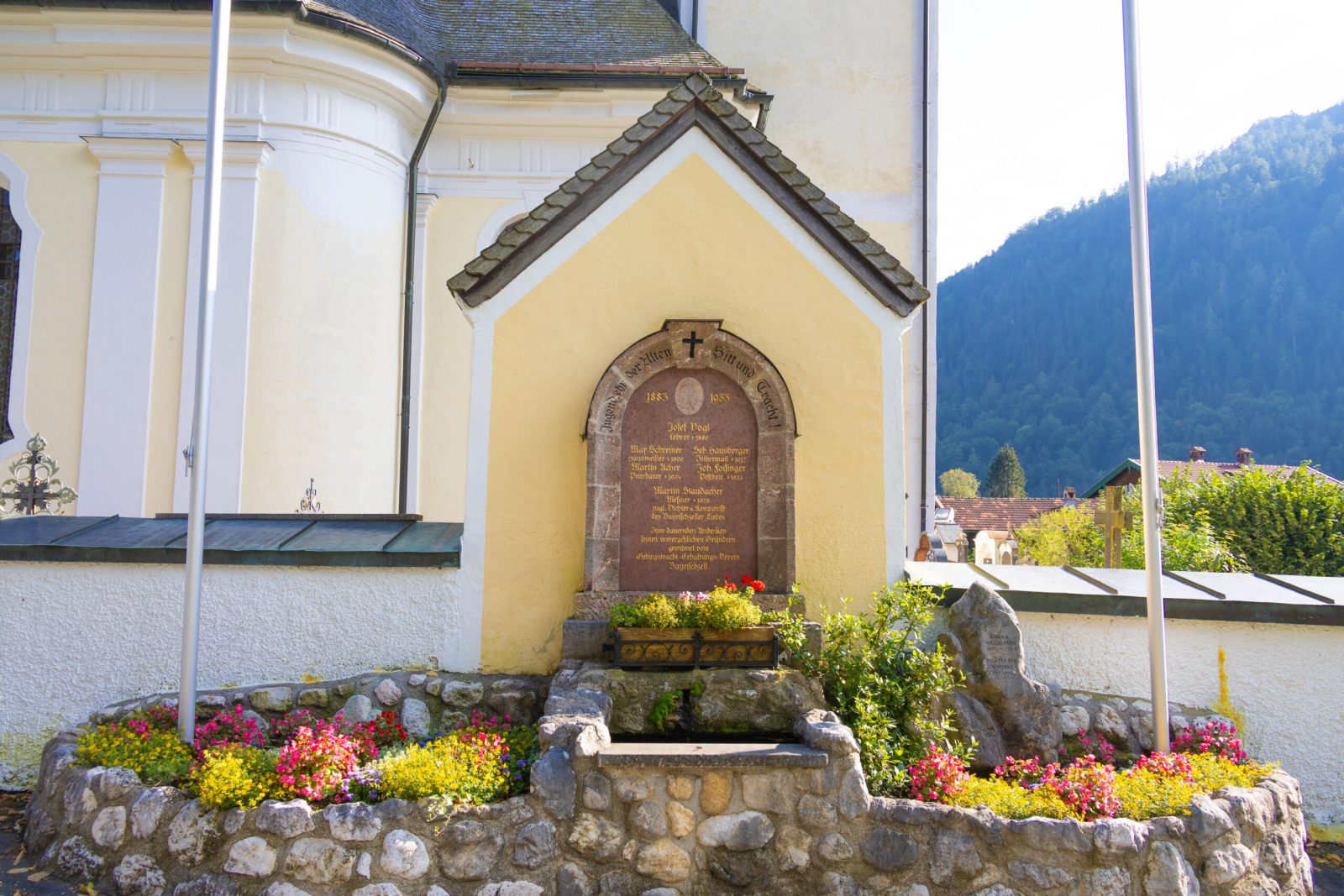
Our walk begins right next to the Haus des Gastes, at a small monument with a fountain. It's easy to stroll right past it, and yet you're standing at the birthplace of something big: Bayrischzell is considered the cradle of the traditional-dress movement.
It all started one Sunday evening back in 1883. A handful of young men were sitting over a beer with their schoolteacher, Josef Vogl, and got to talking about the old mountain folk costume, which by then had all but vanished. Vogl said he'd happily wear it again if only he weren't the only one. One by one, the others agreed to join in, and finally Vogl came right out with it: "You know what, let's start a club!" Three weeks later, five young men and their teacher walked through the village in short lederhosen, gawked at by everyone, and the first step of a movement was taken, one that would later spread across all of Bavaria.
The monument itself was dedicated in 1933, on the club's 50th anniversary. Traditional dress is still very much alive in Bayrischzell today. You see it more than ever at festivals and parades. In everyday life, though, it's noticeably fading, because many of the older folks who once wore their everyday costume as a matter of course are no longer with us. All the more reason for the club to keep the tradition going.
AI-generated narration.
The New Town Hall
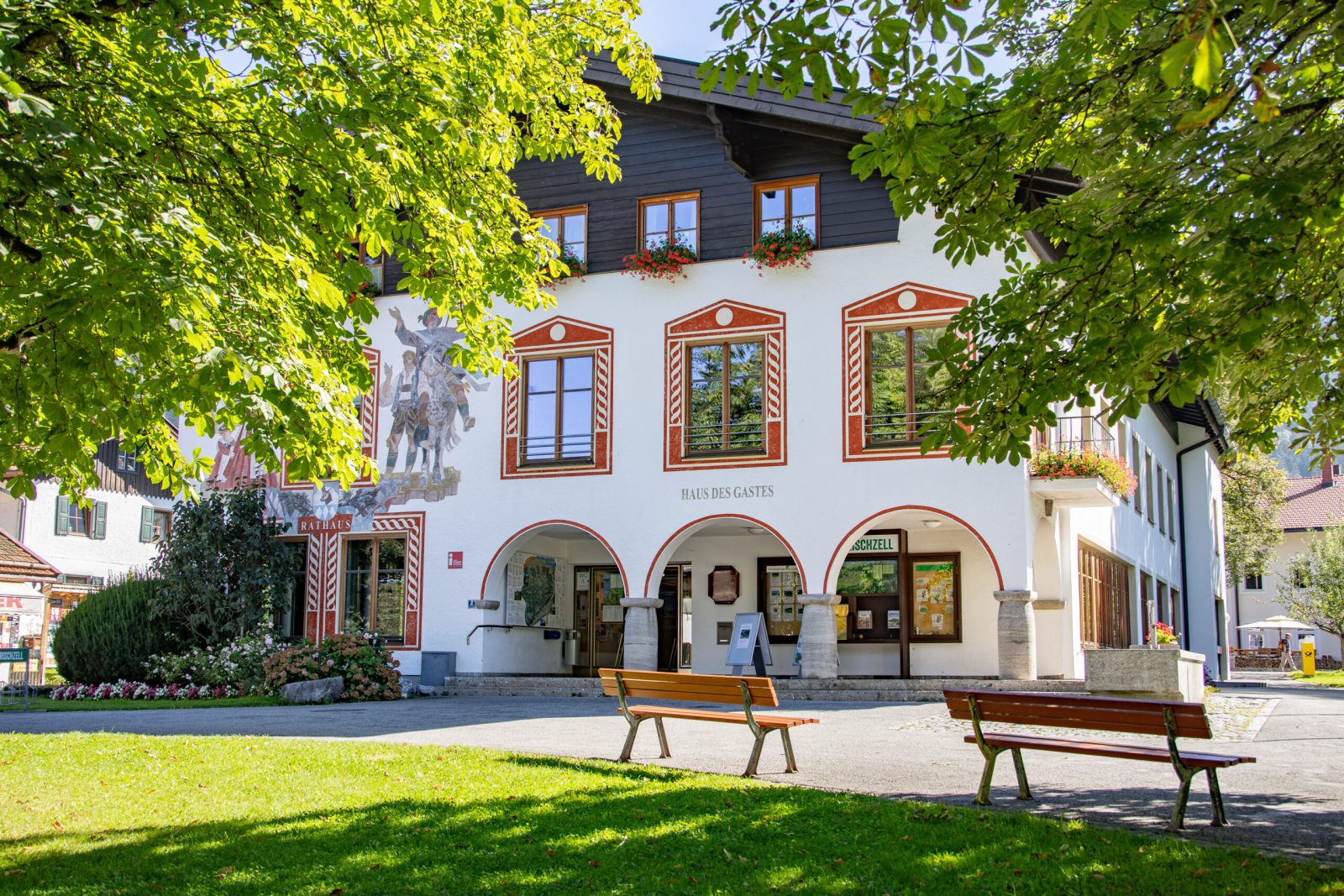
Where the town hall stands today, the "Stefflbauernhof" farmstead once stood for centuries, first mentioned in the records in 1451 and named after Stephan von Lippen, who lived here around 1508. In the 1960s the village wanted to modernize and become more appealing to its guests, so the old farm made way for a new building. The town hall you see now was dedicated in 1966. A piece of old Bayrischzell disappeared to make room for the future.
Look closely and you might notice a resemblance to the town hall in nearby Bad Feilnbach. That's no coincidence: both came from the same architect, Friedl Wegmann of Neuhaus, who around that time became the community's go-to architect. At the dedication, the local paper, the Miesbacher Merkur, wrote that you'd have to travel far to find a comparable building in a town this size.
Today a lot lives under one roof here: the tourist office, the community library, a bowling lane, and the so-called "Salettl," a nicely done reading room with small workspaces where you can settle in and get things done in peace. Pretty up to date for a village town hall.
The War Memorial
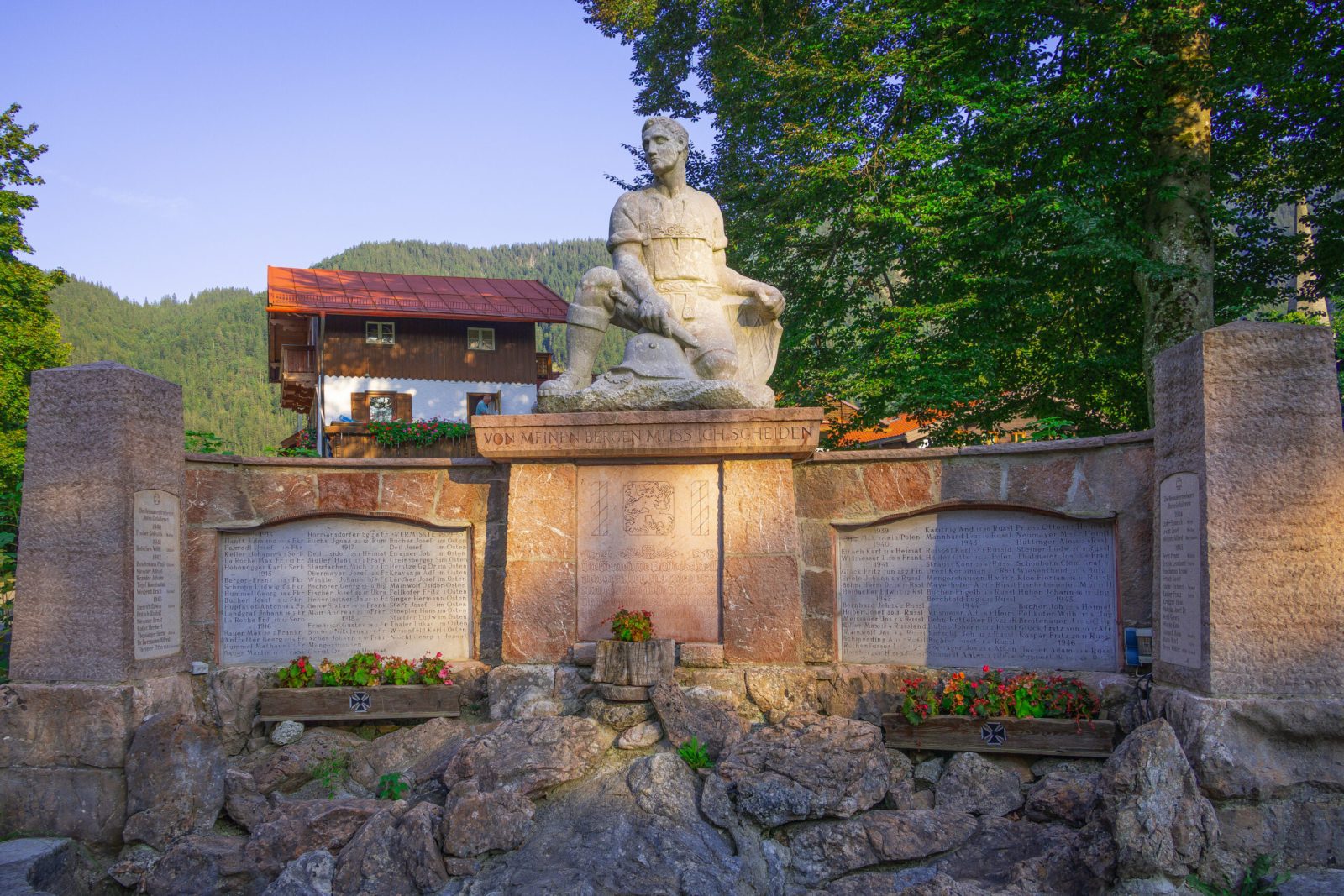
Nearly every Bavarian village has a war memorial. But this one is different, and deliberately so. Instead of a dying soldier, the figure shows a son of the mountains in his native dress: sleeves rolled up, lederhosen, calf-high stockings. His gaze drifts wistfully up toward the Wendelstein, as if he's saying goodbye to his home before heading off to war.
That the memorial looks this way was anything but a given. The idea of showing a mountain man in traditional dress rather than a heroic soldier came from a young teacher named Michael Meindl. At first the village mocked it. People wanted a "proper" war memorial and sneered at his design as the "short-pants monument." Meindl didn't give up. He first won over the influential Count Schönborn, then the hesitant mayor, and finally the well-liked local priest. In the end the idea took hold that here, of all places, in the cradle of the traditional-dress movement, a memorial like this was exactly right.
It was built in 1923, right in the middle of hyperinflation. During construction the money collapsed so fast that a week's wages started out at a few million marks and by the end a single hour of work cost billions. That the community pushed the memorial through anyway, funded by donations and timber sales, was a genuine feat and a real sacrifice. Even the stone belongs to this place: the figure was carved from a massive glacial boulder that lay up on the Geitau pasture and was donated to the community by three local farmers.
Later, more marble plaques were added, in 1952 for those killed and missing in the Second World War, and in 1955 for the displaced who never made it home. To this day the memorial remembers all those who never came back.
The King's Linden
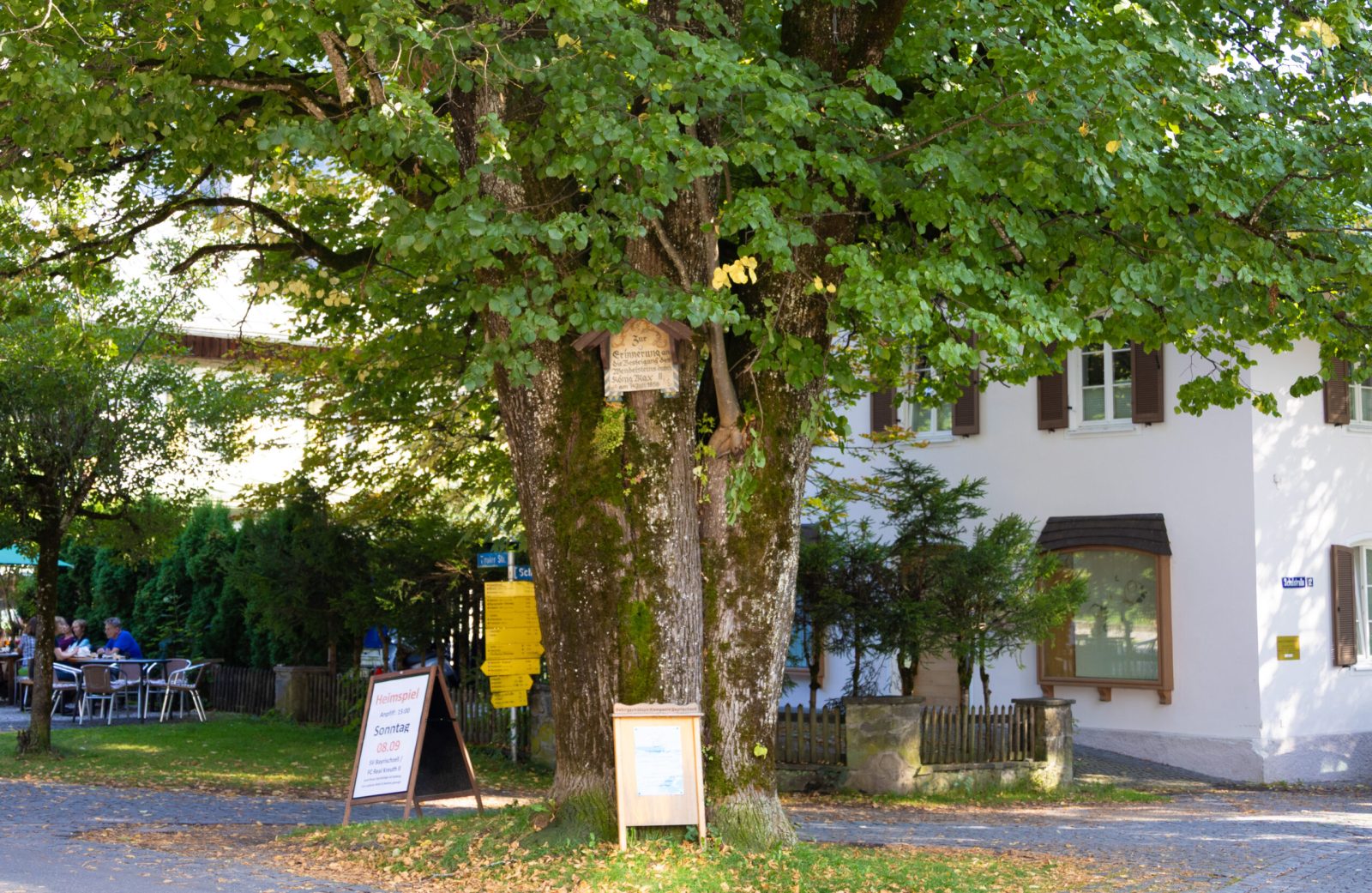
In 1858 King Max II climbed the Wendelstein, and this linden tree was planted to mark the occasion. On July 14 of that year the king paid the village a brief visit. By half past eight in the morning the Zell mountain riflemen were already lined up in full traditional dress, along with singers and half of Bayrischzell. On the way up, the king asked a local farmer, "You must be the King of Bayrischzell?" "Aye," the man said dryly, "that's what folks call me." To which the king replied, "I'm the King of Bavaria, and you're the King of Bayrischzell, so you can lead my horse down for me." And that's exactly what he did.
The king enjoyed it so much that the Steffl farmer suggested planting a linden at the spot where Max II had climbed down from his horse. That little sapling has grown into the mighty tree you're standing in front of today, with a small painted plaque on the trunk that recalls the day.
The historic Maximilian Trail up to the Wendelstein starts nearby, named after the king himself. At roughly three and a half hours of walking with some demanding stretches, though, it's no easy after-work stroll but a serious mountain hike that calls for stamina and a sure step.
The Peterbauer Farm & the Peterhof Cinema
The Peterbauer farm is documented as far back as the 15th century. But the astonishing thing about this place isn't its age, it's what the owner, Maria Hickethier, made of it in the 1950s.
A health resort like Bayrischzell needed entertainment. Guests wanted something to do on rainy days. At first there was only a primitive movie theater, but Frau Hickethier decided to build a modern cinema from scratch. Here's the twist: she didn't put up some plain, functional box. She built the cinema right into her old farmhouse, a venerable farmstead on the outside, a modern movie theater on the inside, already fitted with a CinemaScope wide screen back then. Even pampered big-city guests were amazed that such a thing existed up here. On the second floor there was even a smoking box for 16 to 20 people, where you could watch the film over wine and coffee.
I watched films here myself as a kid. "Stand By Me" is one I still remember well. "Der Bauerndoktor von Bayrischzell" with Beppo Brem ran here for ages, too, an absolute classic. Wooden chairs down below, and photos of old film stars from the '50s through the '70s still on the walls. All wonderfully rustic and just the way it was back then.
And here's a detail hardly anyone knows about: there's a real pipe organ in the theater. When Frau Hickethier built the cinema, the parish church had just bought a new organ, and the old one, played for 80 years, was left over. Instead of scrapping it, Frau Hickethier had it installed in the cinema. It's still there today: first to the glory of God, then to the glory of the movies.
Eventually it came to an end. The growing shift to digital projection made the place unprofitable for a small village operator. Others say fire-safety requirements were what finally tipped the scales. Today the cinema is only used now and then for cultural events, more like once a year than on any regular basis.

The Rosary Chapel
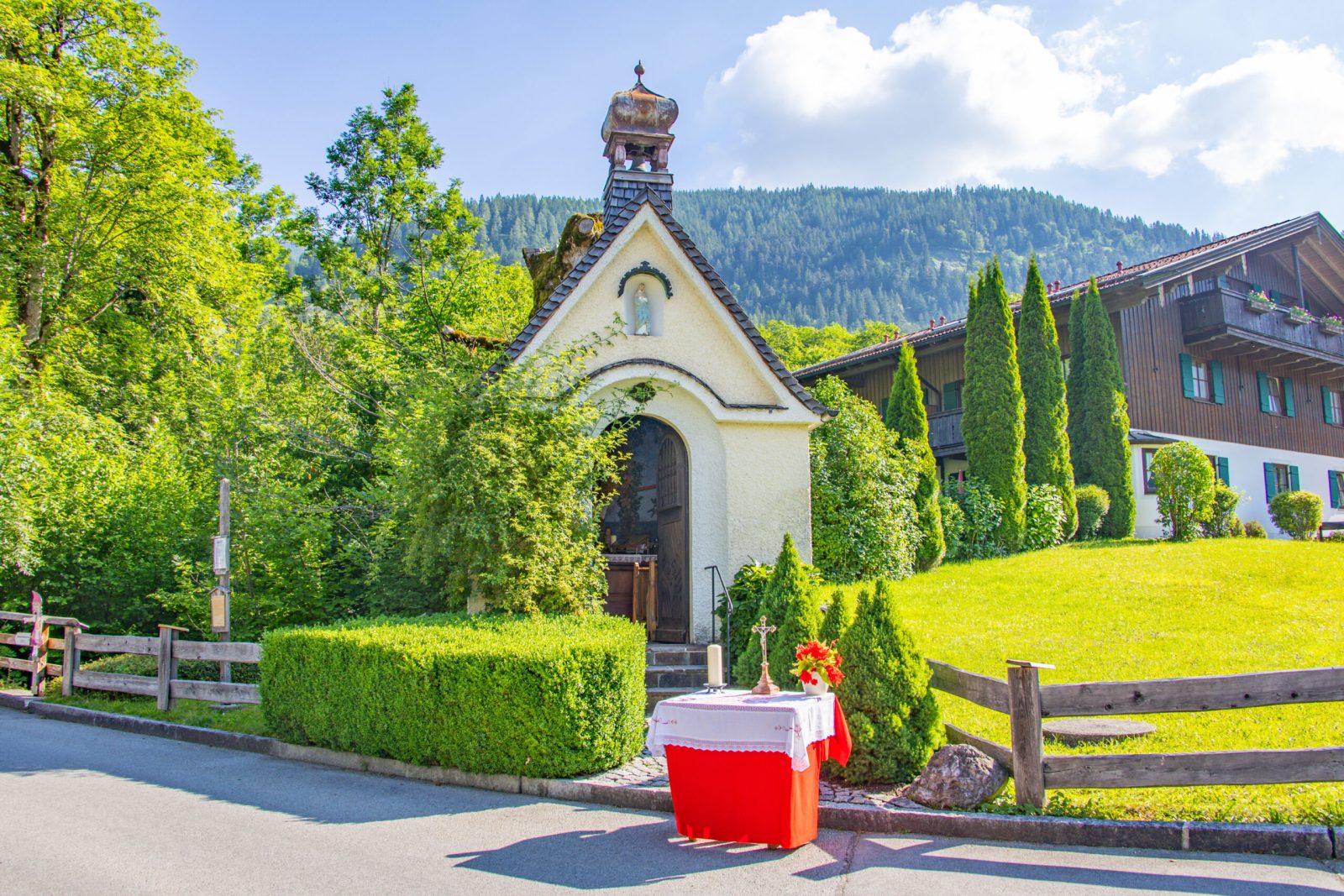
The Rosary Chapel sits a little outside the village center, near the Kneipp park at the Bergfeld. The short detour is worth it, not just for the chapel itself but for the man who built it: Count Clemens von Schönborn. A nobleman from a great family who, deep down, would rather have been a simple Bayrischzeller. Why, the audio guide here on this page tells you.
In 1913 the count had the chapel built beneath a large maple at the edge of his estate, in honor of the Queen of the Rosary. The interior was painted by the artist Count Angelo von Courten. On the altar stands a finely carved statue of the Madonna in the Riemenschneider style, made by carvers from Oberammergau. The rosary that goes with it is said to have come from Palestine and to have been personally blessed by Pope Leo XIII, a remarkable story for such a small chapel. It was dedicated on the first Rosary Sunday of 1913, on the condition that the Schönborn family maintain the chapel for all time.
The Trachten Chapel
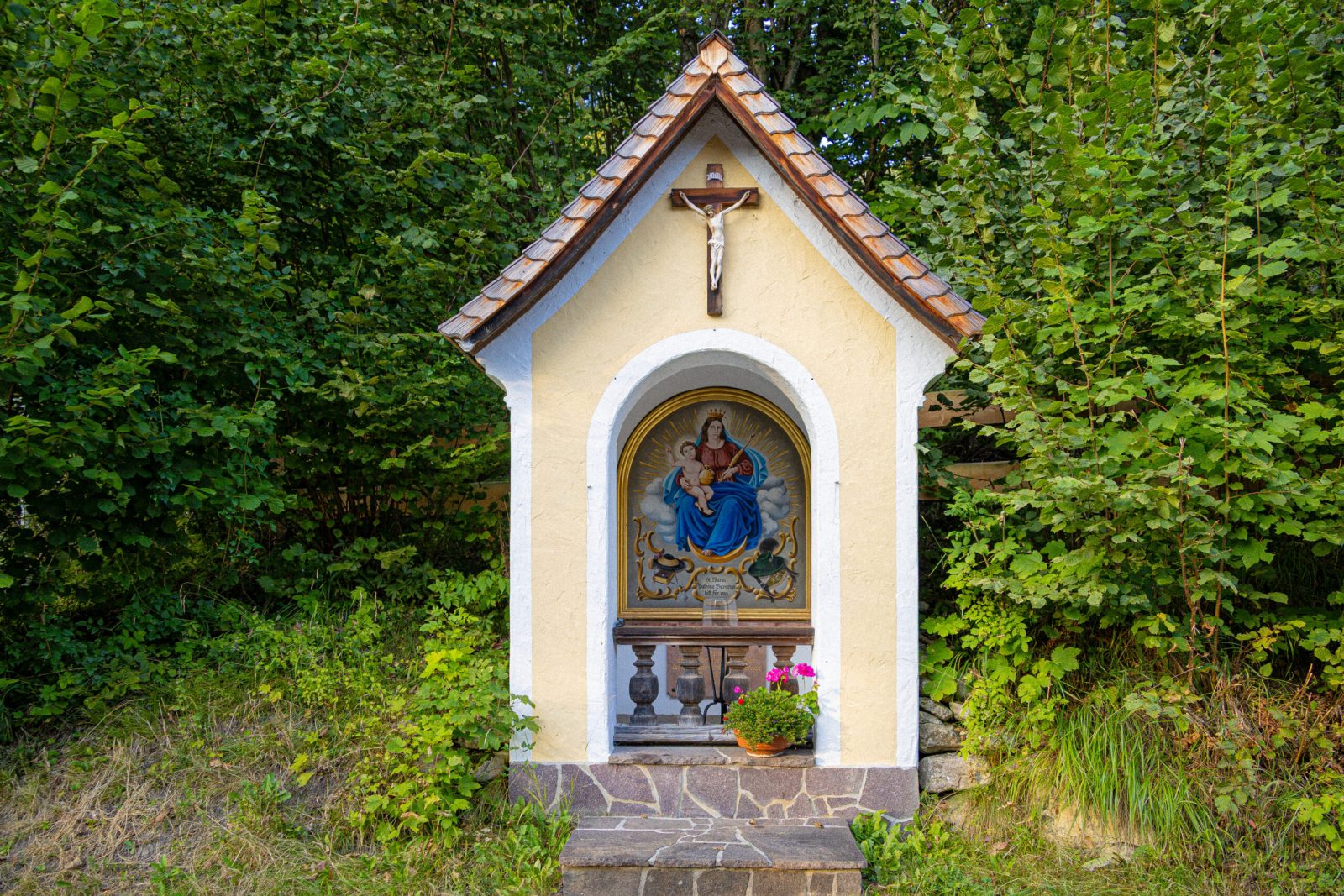
On Lehrer-Vogl-Straße stands a small votive chapel, and it tells more than its size lets on.
It was built in 1982 and dedicated on April 24, 1983, for the 100th anniversary of the Bayrischzell folk-costume club. What makes it special: no construction firm was involved. The members built it themselves, hand in hand, right up to the wooden shingles on the roof.
That it stands on Lehrer-Vogl-Straße, of all streets, is no accident. Josef Vogl was the village teacher who founded the club in 1883. The Trachten monument by the church celebrates that beginning; the chapel, built by hand a hundred years later, shows that the whole thing has stayed alive.
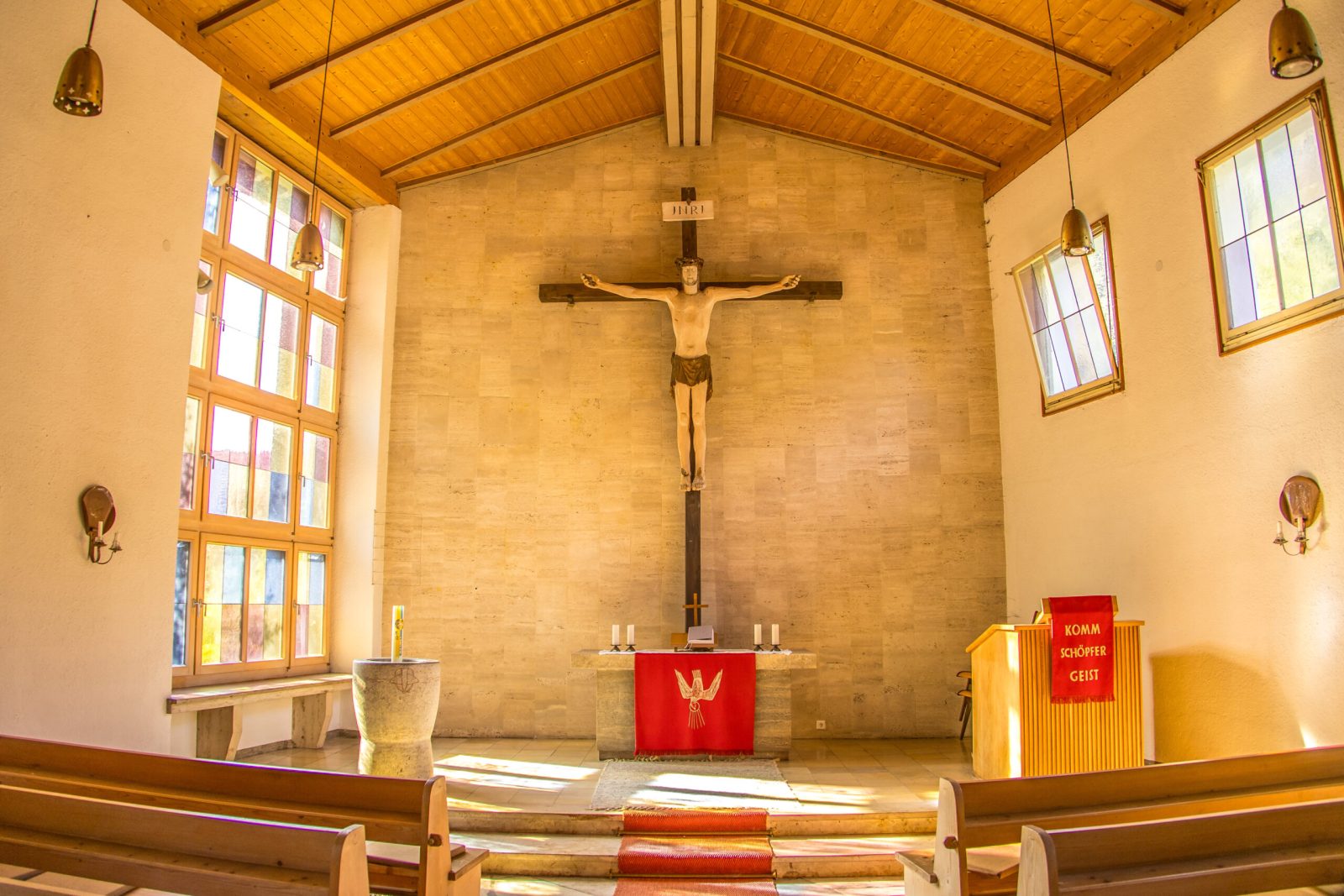
The Protestant Church of the Holy Spirit
A Protestant church in the middle of a Catholic mountain village, and Americans paid for it.
In the 1950s the Protestant congregation in Bayrischzell numbered only around 450 souls, far too few for a church of their own. The push came from an American initiative that built churches all across Cold War Europe, as a sign of peace and a bulwark against communism. Around 86,000 of the total 95,000 marks in construction costs came from that American donation. The building site on Professor-Kleiber-Straße had already been acquired back in 1940 by the benefactor Theodora Scharmann.
Cornerstone in 1954, consecrated in 1955. The design came from the Neuhaus architect Hans Schuhmann, though the tower ended up looking quite different from what he'd first planned. And at the dedication, the Catholic village witnessed a moment almost no one had expected.
The Tanner Mill
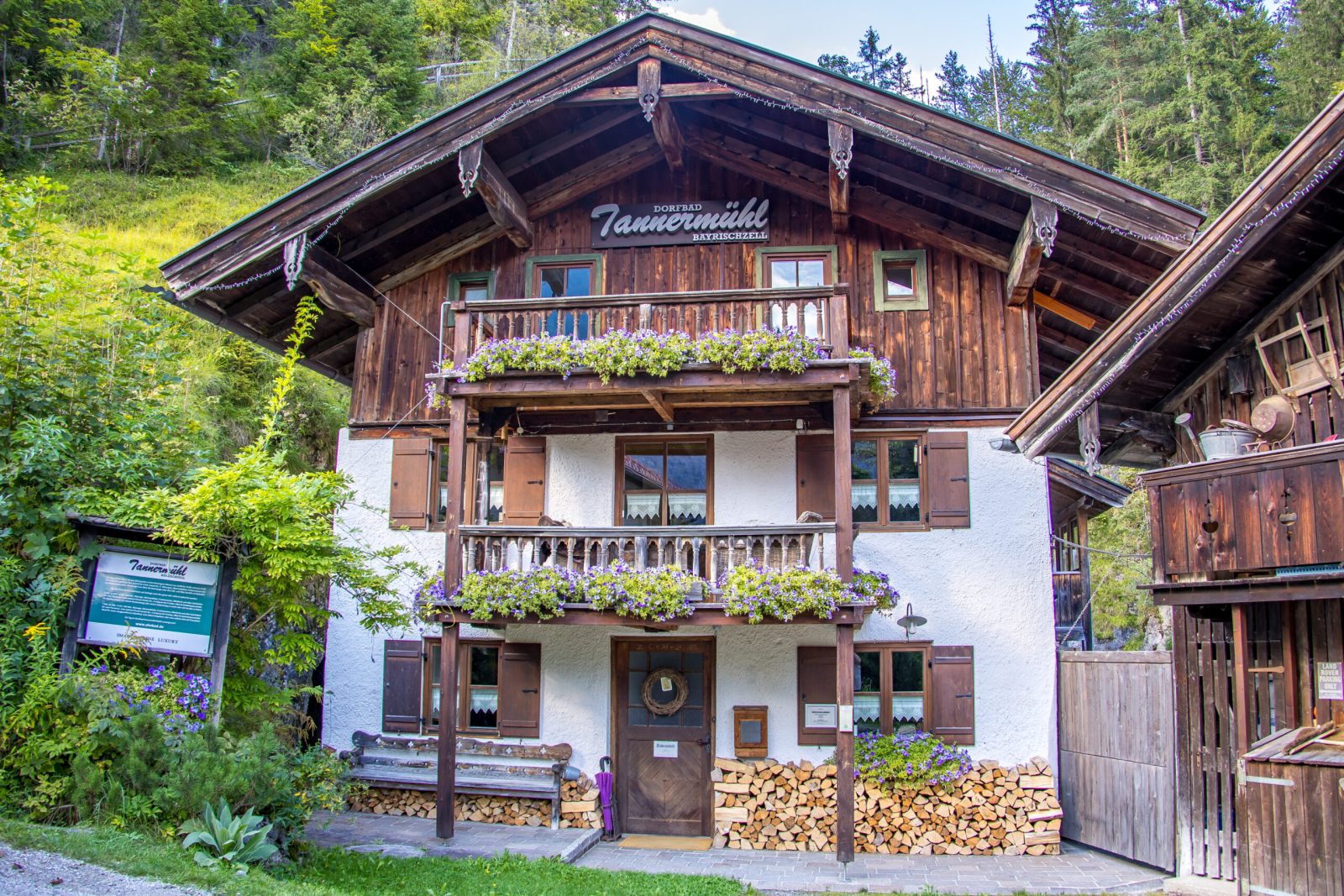
One of the oldest properties in Bayrischzell, tucked into a gorge at the foot of the Wendelstein, right beside an eight-meter (about 26-foot) waterfall.
It takes its name from the Tanner farmer, whose grain mill once stood here; the building you see today dates back to around 1700. When the milling stopped, water power kept driving a workshop through a turbine for decades more, until the operation was electrified in the 1960s. Today the Tanner Mill is home to a rustic village bathhouse.
But the real story of this place goes back nearly a thousand years. The first hermits are said to have settled here, and their retreat is tied more closely to the name Bayrischzell than you might think. Look carefully by the waterfall and you can still make out the trace of their hideaway.
The Tannerhof, Our Final Stop
High above Bayrischzell, on a wooded slope, lies one of the most unusual spots in the whole area: a once-poor mountain farm that became a sanatorium more than a hundred years ago.
In 1905 the lung specialist Christian von Mengershausen and his wife Barbara bought the vacant property, once the farm of the Tanner farmer, to which the Tanner Mill also belonged. Inspired by the "back to nature" movement and the natural healing methods of Father Kneipp, they founded the Tannerhof health retreat, with a treatment philosophy unusual for its day that lives on to this day.
Four generations of doctors have run the place ever since: from therapeutic fasting to a biodynamic garden to today's nature retreat with its award-winning timber architecture.

Up for the Walk?
Ten stops, a good hour, no climbing, and afterward you'll know more about Bayrischzell than most locals do. Best paired with a coffee in the village or a little side trip to the Tanner Mill.
Beim Laden der Karte werden Daten an OpenStreetMap übertragen.
- 1Trachtendenkmal▶ Audio
Text lesen
The walk starts right here, next to the Haus des Gastes, at a little monument with a fountain. It's easy to walk right past it. But this is the exact spot where something began that would go on to shape half of Bavaria.
Let's go back to the year eighteen eighty-three. A Sunday evening, a few of the local lads are sitting over a beer with their schoolteacher. They're chatting about this and that, and they get to talking about the old traditional dress. Because it was disappearing. The short lederhosen, the green hat, hardly anybody wore that stuff anymore. Just one lone hunter, and even he only on rare occasions.
The teacher, Josef Vogl, says: if he weren't the only one, he'd go right out and get himself a set of the old dress again. And the lads feel a little caught out. One after another they say: all right, count me in. And Vogl, bold as anything, comes out with the line that started it all:
"You know what? Let's start a club!"
No sooner said than done. The very next day they send for the leatherworker from Miesbach to sew the lederhosen. And three weeks later, after Sunday Mass, five lads and the teacher walk through the village in short trousers and green hats. People point at them. But nobody cares, because everyone knows they're standing up for a good thing.
What came out of that evening over beers made Bayrischzell the cradle of the traditional dress movement. From that one little gathering grew something that spread across all of Bavaria, from Lake Constance to the Watzmann, and in the end more than six hundred clubs. And it all started right here, on this very spot.
The monument in front of you was put up fifty years later, for the club's anniversary. But the real story is the one about the teacher who got his students, over a beer, to walk through the village in short trousers, and in doing so saved a traditional dress that would otherwise have vanished long ago.
Tradition is still alive here to this day. At every festival, every parade. It didn't end up in a museum, it gets worn. And all of that goes back to this one evening, to this one line: Let's start a club. Right here, in the cradle of the traditional dress movement.
- 2Neues Rathaus
- 3Kriegerdenkmal▶ Audio
Text lesen
Take a good look at the figure. Not a soldier. A man of the mountains, in the local dress: shirtsleeves rolled up, short lederhosen, calf-length socks. One of our own. He's saying goodbye and heading off to war, to protect this home of his.
The fact that he stands like this, and not as a dying warrior, was anything but a given. The idea came from a young teacher, Michael Meindl. He didn't want a heroic soldier's monument, but a son of the mountains taking a heavy-hearted farewell from his homeland.
The village didn't take to it. People wanted a proper warrior's monument, and they mocked Meindl's design. A "short-trousers monument" they called it, with a sneer. A fellow in short pants, when what belonged there was a hero in uniform.
Meindl didn't give up. First he won over the influential Count Schönborn to his idea, then the mayor, who hesitated for a long time. And when the finished model was standing there and the beloved parish priest spoke up for it, the mood turned. People started saying: right here, in the birthplace of the traditional dress revival, maybe a monument like this fits best of all.
And there's something else you'd never guess from looking at the figure today. It was built in nineteen twenty-three, right in the middle of the great inflation, when money was falling apart overnight. When the work began, you earned a few million marks a week. By the end, a single hour of work cost billions. And the village pulled it off anyway, through donations, through selling timber, at enormous sacrifice. They were determined to give their fallen sons a worthy memorial. And they managed it.
Even the stone belongs to this place. The figure was carved from a massive glacial boulder that lay up on the Geitau pasture. Three farmers gave it to the community. So the mountain man is quite literally made from the rock of the mountains he's saying goodbye to.
And now do what the figure is doing. Lift your eyes, up to the Wendelstein.
That's exactly where the man is looking. To Father Wendelstein, as they called it back then. One last look at the mountain that towers over everything, before he goes.
That's what makes this monument so special. It doesn't show a hero. It shows one of our own, someone who loved his home so much that he went to war for it. And who never came back.
- 4Königslinde
- 5Peterhof-Kino▶ Audio
Text lesen
Now it's me again, this is Michi here. This stop I'd rather tell you myself, in person, because I really do know it from the inside.
Take a look at this building. These days you'd walk past it like any old farmhouse. But there's a cinema inside. A real, old village cinema, and I sat in it myself as a kid.
That it exists at all comes down to one woman: Maria Hickethier, who owned the property. Back in the fifties the people here wanted a proper cinema, the locals and above all the spa guests, who wanted something to do on rainy days. Frau Hickethier could have just thrown up a plain functional building. But she didn't.
She deliberately built the cinema right into her old farmhouse. Working with the character of the old farmstead, not against it. A farmhouse on the outside, a modern picture palace on the inside, back then already with a wide screen, with Cinemascope. Even spoiled big-city guests were amazed that something like this existed out here. And up on the first floor, a real smoking lounge, where you could watch the film with a glass of wine and a coffee.
And that's the very cinema I sat in as a boy. "Stand By Me," I still remember that one today. For a long time they also showed "Der Bauerndoktor von Bayrischzell" with Beppo Brehm, that was a cult favorite. Wooden chairs, and on the walls the photos of the old film stars from the fifties and sixties. All of it real, all of it just like back then.
And now take a look around, for the organ. Yes, a real organ, here in the cinema. The story behind it is a lovely one: when Frau Hickethier was building the cinema, the parish church happened to be buying a new organ, and the old one, which had played in the church for eighty years, was left over. What do you do with it? You build it into the cinema. And there it stands to this day.
At some point it was over for the Peterhof cinema. Modern digital projection technology just didn't pay off anymore for a little village cinema, and in the end fire safety regulations are said to have tipped the scales too. These days something only runs here on rare occasions, maybe once a year for a cultural event.
But anyone who gets to have a look inside sees it right away: this is not a cinema like the ones today. This is a piece of time that simply stood still. And whenever I step in there, I'm instantly that boy again on the wooden chair, staring spellbound at the screen.
- 6Rosenkranzkapelle▶ Audio
Text lesen
A little way outside the village center, near the Kneipp park, stands a small chapel. The little detour is worth it, and not just for the chapel itself, but for the man who built it.
That was Count Clemens von Schönborn. A nobleman, yes, from a family that produced cardinals and prince-bishops, with a brilliant military career behind him. But that's not what the people of Bayrischzell remember.
They remember a man who would honestly have loved most of all to be one of them. Who lent a hand himself when his house was being built. Who, for his eightieth birthday, didn't throw some grand affair but instead invited the whole village into his park for a real folk festival. And who once, in the middle of the war, said: when all this is over, I want to grow my vegetables and tend my garden here in the Zell as an old man, and simply be allowed to be among you again.
That's the kind of man he was. And in the year nineteen thirteen he built this chapel here, under a big maple tree at the edge of his property, in honor of the Queen of the Rosary.
Go ahead and step inside, it's usually open during the day. It's surprisingly artful in there for its size. The walls were painted by an artist. And on the altar stands the centerpiece: a finely carved figure of the Queen of the Rosary, made by carvers from Oberammergau, modeled on the old masters.
Take a moment to look at the figure. For such a small village chapel, that's an astonishing treasure.
The count died on New Year's Day nineteen thirty-eight, eighty-three years old, almost at the very moment his son was telling him about a ski jump that had been named after him. With him the family died out here. His old country house is long gone; today the Schönbrunn holiday apartments stand in its place.
What remains is this chapel. The legacy of a count who would rather have been a Bayrischzeller, and whom the people of Bayrischzell still remember to this day as one of their own.
- 7Trachtenkapelle
- 8Evangelische Kirche▶ Audio
Text lesen
You're standing in front of a church that really shouldn't be here at all.
A Catholic mountain village, and right in the middle of it a Protestant church.
For a long time the Protestants here were only a tiny handful. Four hundred and fifty souls. Far too few to ever afford a church of their own.
That they got one anyway, they owe to America.
In the fifties, American Christians set out to build churches all across Europe. A sign for peace, and, in the middle of the Cold War, a bulwark against communism.
A woman from the village got the ball rolling. Through her son, the connection to that American society came about.
And they paid, eighty-six thousand marks. Almost the entire cost of construction. Donated by Americans, for a village most of them never laid eyes on.
The building site had already been secured years earlier by a donor. In the middle of the war, in nineteen forty, she bought the plot.
Even the look of it was a battle.
The architect wanted a charming little church, with an onion dome, thoroughly Bavarian.
To the Americans that was too soft. They wanted it austere. Clean. Plain.
The Americans won.
Lift your eyes to the tower. Pointed, no onion dome. Exactly the way they wanted it.
On Trinity Sunday nineteen fifty-five it was consecrated.
And now comes the best part.
A procession moved through the village, decked out in flags. Out front a boy carrying the cross. Behind him the band, the folk dancers in traditional dress, the mayor with the whole village council.
And the singing came from the Catholic church choir.
The Catholic village celebrated the other side's church right alongside them.
If the door is open, step inside.
Look to the east, at the tall stained-glass window. Two figures, Peter and John. From the side the light streams in in a broad flood, over the altar and the pews.
Some walls divide people.
This one, they all built together.
- 9Tannermühle▶ Audio
Text lesen
Do you hear the waterfall?
Right here, at this water, is where the name of the whole village begins.
Nearly a thousand years ago, so the chronicle tells it, two men withdrew into this forest solitude. Otto and Adalbert. Hermits who wanted nothing but stillness.
One of them is said to have lived by the stream. In a little hermitage, right here, next to the plunging water.
A monk's cell like that used to be called, quite simply, a Zell.
And it's from cells like those that the village up there still takes its name to this day.
Bayrisch-zell.
Centuries later, the water was put to new work.
A farmer built his mill here, and the same water that had given the hermit his stillness now turned the millstones and ground the grain.
And it didn't stop there. When the mill fell silent, the water drove a turbine, and a workshop, right up into the sixties.
For a thousand years, this one stream of water powered everything here.
Step onto the bridge. Stand at the railing.
In front of you, an eight-meter waterfall. Feel how the air turns cooler.
And now look down, at the rock. Somewhere down there, in a cave beside the roaring water, the hermit is said to have lived.
Picture it. No village, no path, no noise. Just a man, the bare rock, and this rushing sound, day and night.
People have been coming to this place for a thousand years. For the one thing the water gives here.
Peace.
And that, to this day, hasn't changed one bit.
- 10Tannerhof▶ Audio
Text lesen
Look up the wooded slope above you, to the little wooden huts.
In one of them, strangers slept. With the window wide open. In the dead of winter.
And that was on doctor's orders.
Up here there once stood a poor mountain farm. Barren, remote, and in the end abandoned.
Then, in 1905, a lung doctor bought it.
He believed in something that sounded almost crazy back then. That the best medicine isn't on the pharmacy shelf, but out here. In the mountain air. In the forest. In the stillness.
So he built huts on the slope. Air huts.
Whoever was ill, whoever was worn out, whoever simply couldn't go on, came up here and breathed.
Over it all stood his motto. An old verse:
Human being, become essential.
That idea never died.
Four generations, all of them doctors, carried it on. The therapeutic fasting.
The poor farm had long since become a famous place. Even a German president came back up here again and again over the years.
Look once more at the huts on the slope.
Imagine yourself lying up there. No phone. No noise. Just cool mountain air, and the rustling of the trees.
For over a hundred years, people have been coming here for exactly that.
The farm once supplied the village with grain.
Today it gives people something far harder to come by, the permission to become essential again.
Tipp: Auf einen Eintrag in der Liste oder direkt in der Karte tippen.